Monday, May 14, 2012
Sharon Namubiru from Sabina to teach on PDC in Uganda!
Sunday, March 18, 2012
Nyero Christopher's Permaculture Journey
WEDNESDAY, MARCH 23, 2011
My small village
After the peace has been restored, people started getting back to the country side and the Village is breathing again. But still everyone who is over 18years of age here has fresh memories of the Lord’s Resistance Army {L.R.A} war that left many family members dead. It was horrible, terrible, deplorable, and sad and causing sorrow seeing the killing of humans; we really suffered so much at the hands of the L.R.A. By the time I left for Kampala, the situation had worsened and to me, it breaks my heart whenever I flash on how people suffered. On the other side of business, agriculture is still the main economic activity.
Though the Village doesn’t have any Industrious farmers and instead they do the farming in a Subsistence way, but still Villagers produce enough food for the community and supply the few to the town in exchange of money. People mainly grow cereals crops like rice, millet, sorghum, simsim, beans, pigeon peas, cow peas, soya beans, cassava among others and vegetables include cabbage, egg plants, okra etc. Villagers also keep some poultry birds like pigeons, chickens, ducks and turkey, and animals like goats, sheep, pigs and cattle.
With the land issue, here people face problems of land wrangles as they have just got back to the country side after the peace restoration in the area. With modernity, my Village unfortunately is trying to replace rural lifestyle slowly with urban ways of life style. And boys have adopted some for example boys play cards and gamble all day long. Instead of engaging in Income generating activities. I wonder up and down because others drink alcohol for breakfast-they start from morning! And only God knows where they get the money to sustain that kind of lifestyle.
Under modernity still, no storey buildings are replacing our traditional mud and wattle grassed thatched huts. With Music and Entertainment, the days of Larakaraka, Dingi-Dingi and Bwola among others of the 1960s are long gone and were the days of my father. Here the youth buy Music played by foreigners for as cheap as1500 [Ugandan shilling] on a CD. Others even record songs on their Mobile phones with the help of memory card. If it comes to modern dance, youth here love dancing modern dances and at times they hold each other’s waist and squeeze each other- which are a new way of dancing that has affected youth in the area due to modernity. And for those who may have time and can afford paying dance fee, they either attend to the one within the Village or go dancing in Gulu Town which is about 30-40 minutes ride on a Boda-Boda. With the fact of many and different friends with different minds and characters, they always close up the Dance with fighting among them self.
My Father-Mr.Kolo Bilentino, told me that he miss the moon light dance of their good old days when they were real men. He added, “We used to go hunting wild animals, birds and dig big gardens to prove our manhood and this is why I have a very big piece of Land. A real woman used to stay home to do house hold chores like fetching water, cleaning utensils, sweeping the compounds and preparing local dishes. Today, they use machines to make Odi {ground nut and simsim paste}. Really gone are the days of the grinding stone”.
As different Tribes with different likes, so here Youth mostly take Xmas, Easter and Independence Days as their Days of showing off. So these are the most days you will see youth dressed in different ways depending on the weight of their Wallets. They try all their level best to be different on such days so that to refresh their minds off the L.R.A periods. Boys put on heavy clothe, Jungle shoes with a baseball cap on top mostly in a 50 Cent way of design. For girls, they look for nice designs of hair and nice looking dresses that can match with their choices.
Yeah, on the side of Early Marriage, both girls and boys are in early Marriage. Children’s Activist and NGOs have tried to stop early Marriage in this Area like it does in other areas but tradition always wins as transactions are carried out secretly. Dowry here is not so expensive and give people chances of Early Marriages. In the past, early Marriage was un-heard of, but has grown with the problem influx of poverty among families, can you imagine?
With the tradition mud and wattle grass thatched hut everywhere, with dusty narrow road that passes through, and you will never see any electricity pole here! On top of all that, it is my favorite place when I need to get away. In my homeland and I’m feeling so alive cause it’s where I was born and it’s where I did my nursery class from-my first class room to be was under a mango tree and i would writie on the soil because I could not have a book and a pencil to use.
I love the Village and it’s my first choice area to develop so as to become known worldwide. I always enjoy getting back to Village for my December holidays. Really this is where Nyero Christopher comes from and it is where I belong.
Sunday, October 9, 2011
The Sabina Permaculture Garden at the heart of school and community life.
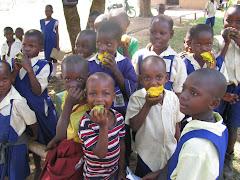
The aim of the curriculum is to balance the good work that has been done at Sabina on developing the academic side of school learning, with an equal emphasis on developing valuable vocational and life skills for the children. The hope is that every child who comes to this school will be able to live a meaningful life, and produce food, even in the absence of ‘professional employment’.
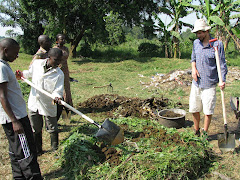
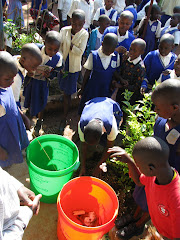
We also aim to share the benefits of the garden with the whole school community, including the families and guardians of children who attend the school. We want to produce a varied array of fruits and vegetables for all to share, to spread skills and love for permaculture principles and ethics, and also to use the garden as a site for hands on learning across the academic disciplines. Much of the valuable work in producing food for the kitchen is now being done by children, led of course by the wonderful James Kalokola and Anna Kisakye Nakibinge, the students of the Permaculture Club and the class teachers.
It is inspiring to see how teachers at the school have embraced the garden, appreciating its beauty as well as its productivity. In the time that I was there, we explored the opportunities a garden creates to think imaginatively about teaching and learning, and we came up with a concept that places the garden at the heart of the education offered by Sabina school.
Using the beautiful garden as central to learning, we talked of it as the basis for:
· Educating children in life skills – useful knowledge
· Food and water security – leading to healthy communities
· Educating children to shape their future – democratic citizenship
· Global responsibility and sustainability – caring for our planet
· Disciplinary and academic development - including literacy and numeracy and the skills required to perform well in national testing, as well as science, agriculture, the arts, the humanities
· Thematic and interdisciplinary learning – including problem solving and integration of theory and practice
· Opportunities for children with a range of learning styles – hands on learning, co-operative learning, differentiated tasks
· Improved diet and well being of children - hence optimising potential to learn
· Building positive links with the community through opportunities for sharing produce, running short courses for parents and guardians, inviting others in – including local and district schools
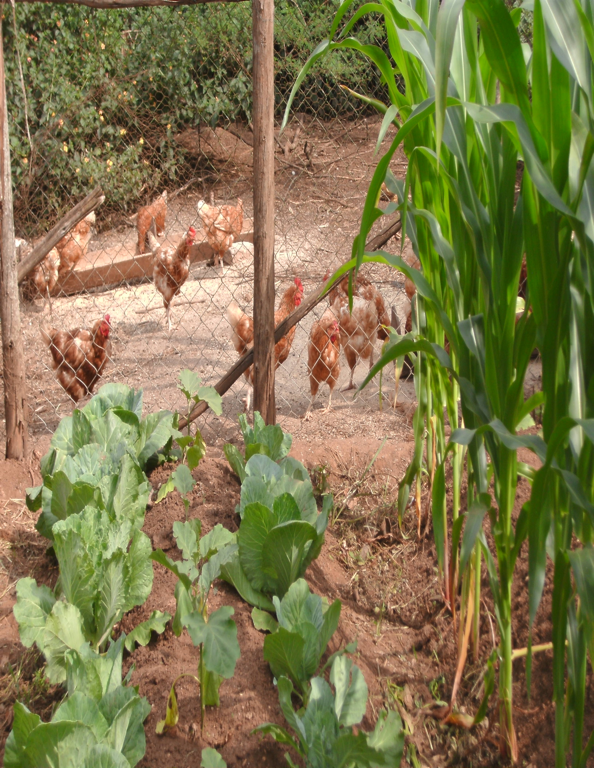
Teachers are now working on the many ways they will integrate permaculture and national curriculums. Think for example of the ‘problem’ of the chickens. The home has 70 hens which are laying about 60 eggs a day. Children are given an egg a week, other eggs are used in the kitchen, and surplus eggs are being sold in the village of Ssanje. This earns a little money that is put back into the garden. But chicken food is expensive, and we need to know whether our chicken project is cost effective? Here is a research question that can be given to senior primary students to work on together.Such research would involve counting eggs, developing a system of record keeping, drawing graphs, costing the regular expenses of chickens, charting the income from eggs, even ‘accounting’ in some way for the improved well being of children. It could require a written report at the end, maybe with illustrations.
The audience for the report would be diverse - James as manager of the FWS project, Margaret Kasekende as CEO of Children of Uganda, perhaps even the Children of Uganda Board. Such a research project would offer opportunity for learners of all kinds to draw some conclusions about a question that is very important for the organisation. It would put literacy and numeracy skills to good use, and children might even be involved in presenting the data orally in a formal way.
Our next step is to develop a beautiful poster which encapsulates this idea of the place of the garden in the life of the school and community. This can be placed in each classroom, in the kitchen, and shared with other community members and schools. It will act as a visual representation of our philosophy, and something to be proud of."
Saturday, August 27, 2011
Growing a Better Tomorrow: A Sustainable Plan for our Future
Posted by Jan Smart, Vice Chair (Programs), Board of Directors, Children of Uganda
Wednesday, August 24, 2011
Permaculture progresses at Sabina
In the background of the photo above, you can see the school buildings. Water falling on the rooves is collected in the gutters and stored in the rainwater tanks. The collected water is used to water the vegetables, as drinking water for the chickens and in dry spells is used by the kitchen.
Sabina pupils help prepare harvested maize for cooking
Older COU students volunteer
Nyero Christopher and Yiga Tom have been volunteering at FWS during their form four vacation. These young men give us hope that there the new generation in Uganda will lead meaningful lives. They have volunteered of their own accord. This is the spirit of giving and hard work that we would like to inculcate in children. We would like them to think ahead to their survival after school. These two young men are now studying at Butende Technical Institute, continuing to improve their skills in construction. With so many skills under their belts they will undoubtedly do well after school.
This woodlot, a FWS project, consists of approximately 24,000 eucalypts. Children of Uganda will save money spent on firewood, an expense that strains its coffers. The woodlot will also generate income for Children of Uganda by through the sale of excess fire wood or poles. The money saved and generated can be used to improve the welfare of children.
Tuesday, August 23, 2011
Moving forward with food and water security at Sabina
My name is James Kalokola and I am the Assistant Program Manager at the permaculture project at Sabina, which has been renamed: Sabina Food and Water Security, or FWS for short.
About me and my journey to permaculture
My journey to FWS and permaculture started when I spotted an advertisement for the position of program assistant with FWS. I applied, hopeful that my qualifications and experience in agriculture would get me to the interview stage. To my pleasure I was shortlisted and, after an interview with representatives from Children of Uganda as well officials from the Rakai District Agriculture Department, I was chosen for the job.
But I don’t want to call this just a ‘job’ – it is much more than this for me. I’m passionate about the aims of this project and the values it represents, and I’m committed to improving it and achieving the best outcomes possible.
As a holder of a Bachelor of Science degree in conservation biology, I met the qualification requirements for the position. But I think that what is perhaps just as important is that I was born into and raised in a family that not only practices agriculture but values it, something which is unfortunately not always the case in modern Uganda where the lure of the city is strong. My training and my additional part-time work as a teacher at a local agricultural high school has also given me considerable experience interacting with students and the community.
Permaculture enters my world
To be frank, before I was appointed to this position in January 2010, the word ‘permaculture’ was not part of my vocabulary. The first time I heard it was when I met Jan Smart, Vice Chair (Programs) of Children of Uganda Board of Directors, to discuss the position. Jan introduced me to Dan Palmer, an Australian volunteer who was one of the designers of the original permaculture site plan. Dan is a softly-spoken man. After greeting me, he asked a question of me: “Have you ever heard of Permaculture?”. I knew immediately I was in the hands of a good teacher. I replied immediately: “No”.
Then Dan said simply and quietly, “It is permanent agriculture“, and stopped there, leaving me wondering . He knew instinctively that I would be intrigued.
I left the meeting full of curiosity, determined to investigate further and leave no stone unturned in my quest to understand the concept. When I got back to my home town of Kyotera in Rakai district, I jumped on the internet and did some research. Oh my, what a lot of information on permaculture there was. But I still did not dream that this new word would be such a crucial part of my role at Sabina. And the idea that someday I might even start to teach it was not even on my horizon of thought.
Learning about permaculture
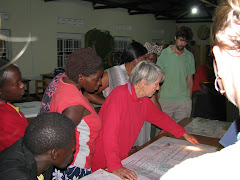
Attending the January 2010 Permaculture Design Course at Sabina School was really the turning point in my journey from conservation biologist to permaculturist. This was the first Permaculture Design Course ever held in Uganda and I attended along with 50 other participants from different corners of the world, including Kenya, Tanzania, Canada, Australia, and the UK. You can read more about this course here and in earlier posts in this blog, including this one.
The main instructor was Rosemary Morrow, a world famous permaculture practitioner and teacher based in Australia. Her teaching colleagues were Dan Palmer, Amanda Cuyler, Lindsay Dozoretz, Claudia and Rachael Otuyar. Rachel is an African lady who works on a farmer-extension project in Kenya run along conservation farming lines. Her knowledge of permaculture came from her time working at St Judes, an organic farming training site in the Masaka district close to Sabina. St Judes is designed along permaculture principles,
On the first day of the course, Rosemary Morrow introduced the concept of permaculture and explained its origins and context. As the course progressed, my understanding of permaculture kept expanding and changing, as we moved from topic to topic. At one point, I saw it as ecology, at another I understood it as organic farming, and then further as physical planning , disaster management, and much more. This segmented understanding continued until the final days of the course, when it all started to come together holistically.
In a way, my initial disjointed understanding of permaculture is instructive. Permaculture does indeed have many disciplines embedded in it. All the topics and approaches above are part and parcel of permaculture. The confusion I faced is one that I suspect anybody new to the field of permaculture would be likely to succumb to .
I now realise that the ‘ingredients’ of permaculture can be found in other areas of knowledge, but the way they are presented creates a unique style of designing and living, which I would urge anybody to venture into. But I have one word of caution, based on my own short but intense experience of permaculture: once you decide to investigate, you will end up digging into it deeper and deeper.
A word of thanks
Though my professional background helped me adopt permaculture practices, I would also like to thank all the permaculturalists who have been involved in FWS, including: Rosemary Morrow, Dan Palmer, Amanda Cuyler, Mike Cloutier, Ralph Skerra, Kim Glasgow, Clive Mullett, Michele Sabto and Andy Trevillian, Cameron Cross and Symmone Gordon, and of course Jan Smart.
Stay tuned to find out all about recent progress at FWS. New posts will be up very shortly!
James Kalokola, FWS Assistant Program Manager